Trust Center
Responsible AI
How Magif agents are meant to be used, where their limits are, and how humans stay in charge.
Last updated: 21 September 2026
What Magif agents are
Magif agents are AI assistants configured by professional creators (coaches, trainers, consultants) from their own methods and content. They support and extend a human practice; they do not replace it.
On this page, end users means your clients: the people who chat with your agent. You, the coach, define the method behind it.
Intended use
Coaching-style guidance, learning support and structured self-reflection for the creator's clients, based on the creator's material.
Limitations
Agents are useful within a clear scope. These limits apply to every agent on the platform.
- Agents can produce inaccurate or incomplete answers. Output should be treated as guidance, not as fact or professional advice.
- Agents are not a substitute for medical, psychological, legal or financial professionals.
- Agents work from the creator's content; the creator remains responsible for that content.
Human responsibility and oversight
Prohibited and restricted uses
The following uses are not permitted on the platform.
- Medical diagnosis or treatment decisions
- Legal, financial or safety-critical decision making without human review
- Processing of data the creator has no right to use
- Deception about the AI nature of the assistant
Model governance and traceability
Models are selected and updated centrally by Magif. Model changes are rolled out platform-wide with monitoring, so behavior stays consistent and traceable across agents.
Current model architecture
What class of model runs the agents, and how Magif keeps models current.
Core agent inference
Core agent inference runs on open-source models hosted on Scaleway in the European Union.
Creator assistant
The MAX creator assistant runs on foundation models served through AWS Bedrock in the EU region (Paris, eu-west-3).
Model updates
Magif manages model selection and upgrades centrally. Production model changes are evaluated internally before rollout, so behaviour stays consistent and traceable across agents.
Escalation
- End users can reach the creator behind an agent, and any user can contact Magif support to report a problematic response.
- Reports go to [email protected]. Every report is reviewed.
EU AI Act transparency
EU AI Act readiness
Ready- Applicable EU AI Act requirements
- Implemented
- Intended-use risk position
- Not high-risk
- AI transparency
- Implemented
- Human oversight
- Implemented
- Assessment basis
- Internal assessment
AI-interaction disclosure
ImplementedEnd users are informed in the chat interface that they are interacting with an AI assistant. This control is intended to support the applicable Article 50 transparency obligation.
EU AI Act status
Magif's current EU AI Act position, based on an internal review.
Assessment date
21 September 2026 (internal review)
Magif's role
Magif provides the Magif AI-agent platform. Customers configure and deploy agents for their own intended use. The AI Act role and obligations applicable to each deployment depend on the system configuration and use case.
Intended-use position
Magif is not intended for the high-risk uses listed in Annex III of the EU AI Act. Customers remain responsible for assessing whether their specific deployment introduces additional obligations.
Classification
High-risk classification: not intended for high-risk uses as listed in Annex III; deployment-specific uses remain the customer's responsibility.
Transparency controls
Transparency controls implemented: AI disclosure, creator responsibility, human oversight.
Limitations
This is an internal assessment. No external conformity assessment has been completed.
Testing and evaluation
Agent behavior is tested internally through manual review and scenario testing during development and before releases. There is currently no formal independent evaluation; independent assessment status is listed on the Security page.
What end users see
End users are told they are interacting with an AI assistant. The chat interface identifies the assistant as AI and names the creator behind it.
Verified 21 September 2026View the walkthroughHide the walkthrough
Every client is told they are talking to an AI before they can chat, and they can revisit that disclosure at any time.
- 1
A client opens a published agent for the first time
On the first visit, before any message is sent, the disclosure appears over the chat.
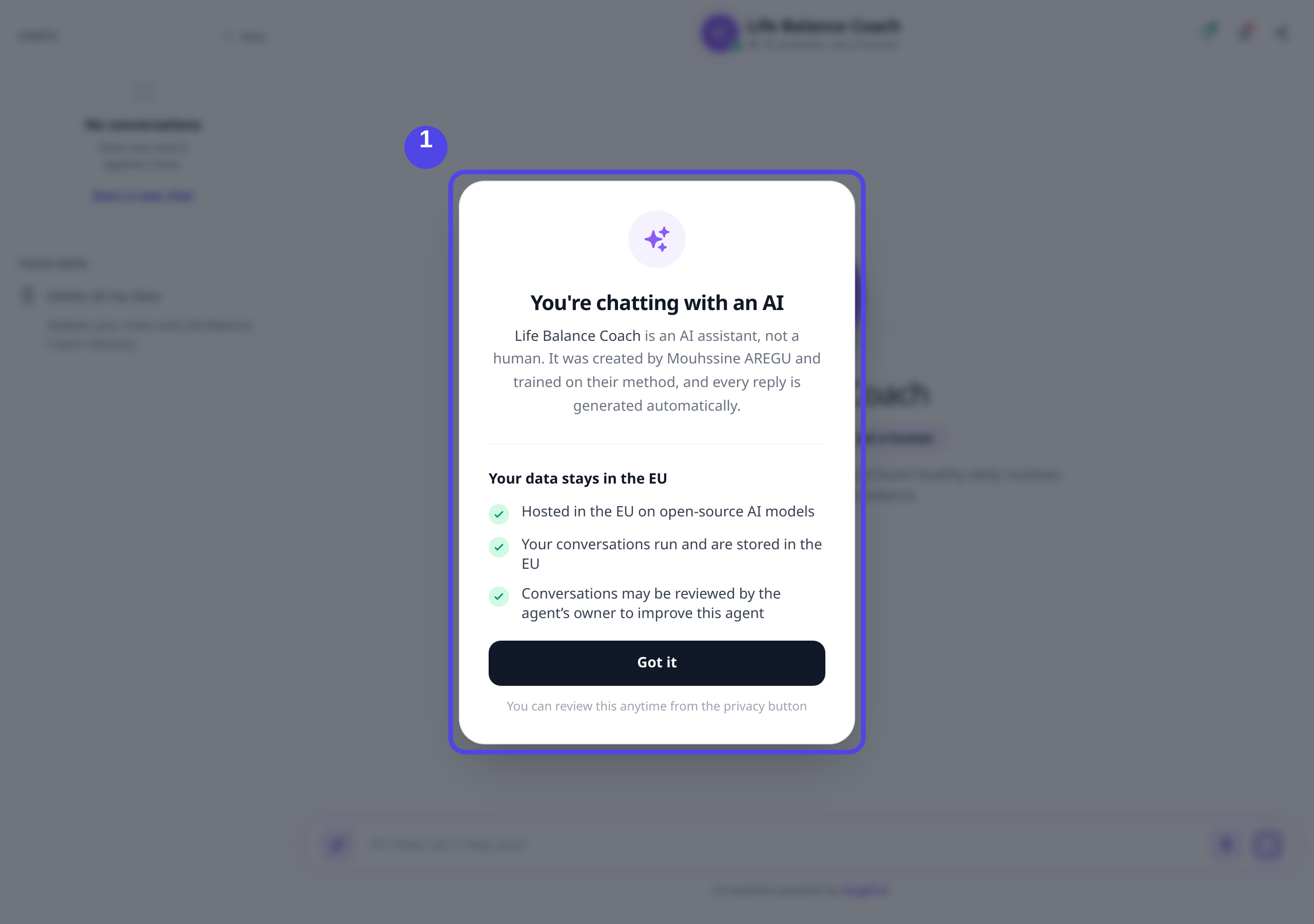
The first visit to a published agent, with the disclosure shown before chatting. Opens full size in a new tab. - 2
The disclosure names the AI and its creator
The client is told the agent is an AI, not a human, who created it, and that every reply is generated automatically. It also states where the data is handled.
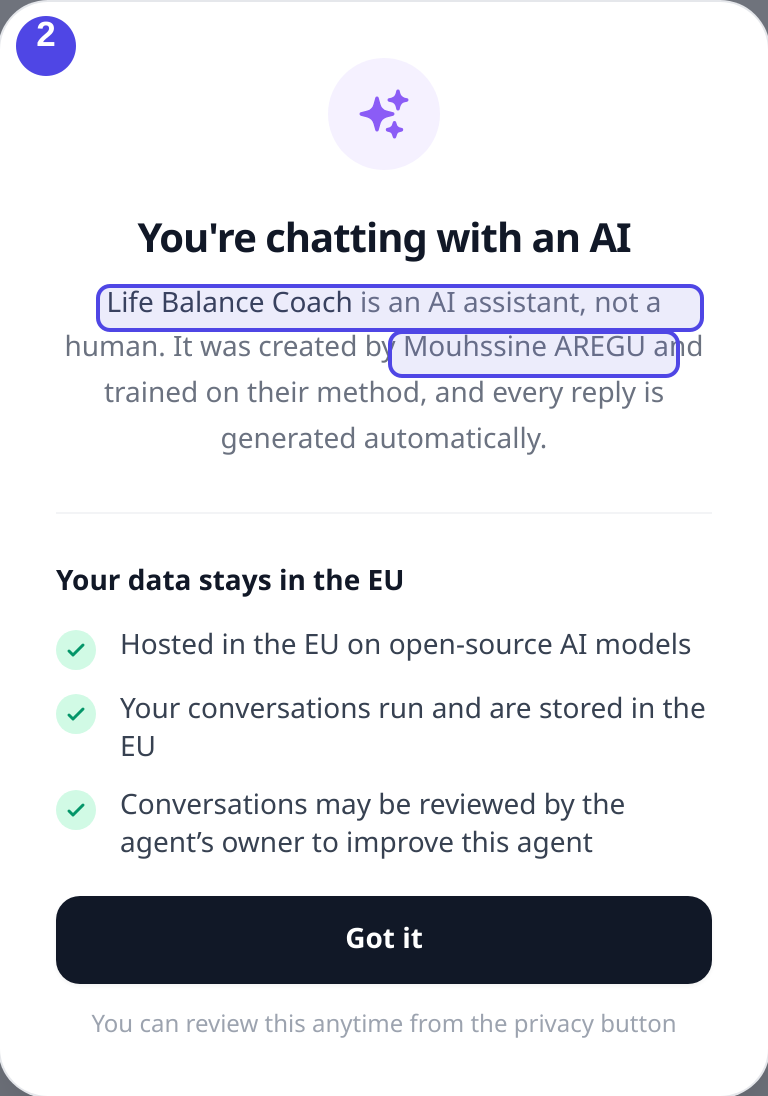
The disclosure a real client sees on a live agent. Opens full size in a new tab. - 3
The disclosure can be reopened at any time
A persistent privacy control stays on the chat so the client can reopen the disclosure whenever they want.

The persistent privacy control that reopens the disclosure at any time. Opens full size in a new tab.
Captured on an isolated staging replica of the production system, 21 September 2026. Names, emails and record identifiers are redacted for publication.