What a sharp critique of AI in coaching taught me, and what the research says
This week, a fellow coach, Elaine LEEN, shared how she offers Elan, her AI agent, to the people she coaches. It’s a thinking partner between sessions. It doesn’t replace coaching, it extends it.
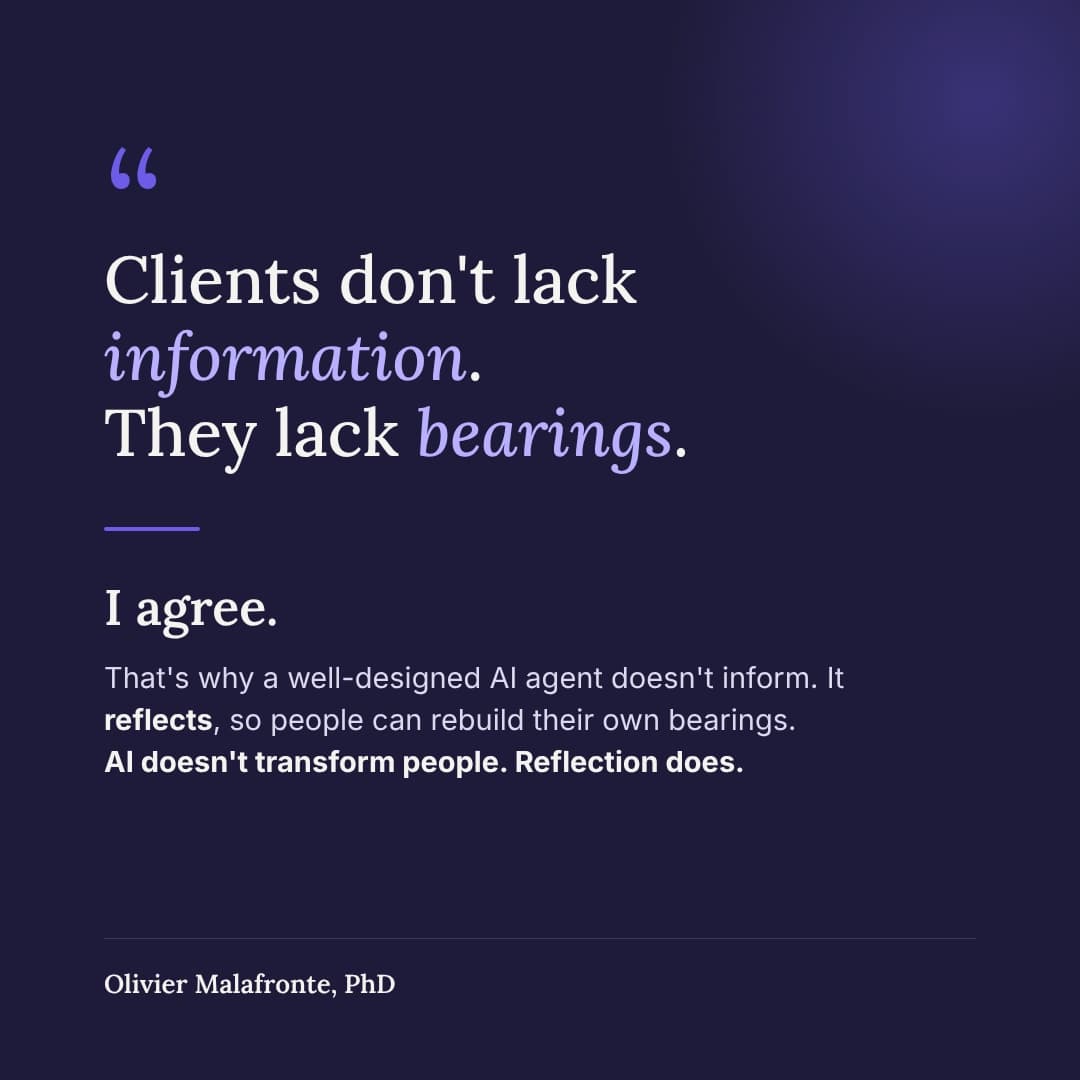
The most valuable reply came from someone who disagreed. Claude, a coach, author and trainer, pushed back hard. To him, an AI agent between sessions makes clients dependent instead of autonomous. An AI doesn’t recognise its own mistakes. And coaching should remain a craft of repeated human co-presence, nothing more. Then came the sentence that stayed with me: clients don’t suffer from a lack of information, but from a lack of bearings.
I replied in the comments, in six points, a little too fast. Here is the longer answer that a critique of this quality deserves.
Why I do this work
I started working on AI in coaching because of my own story. At 20, I faced professional and personal challenges that were close to paralysing, and I had no means to work with a coach. It became clear to me then that technology should help in the moments when human resources aren’t available.
The positive feedback from my first years of work, from 2015 onwards, convinced me that real impact was possible. Questions kept bothering me, though, so I went back to study them in a PhD.
I also share part of Claude’s view. A world without technology, focused on human relationships, might well be better. But that’s not the world we live in. People already use technologies that don’t always serve their development. My work is to help make technology a resource for self-knowledge and growth.
Nor is AI an intrusion into a “pure” profession. A historical study by Deryk Stec (Journal of Management History, 2012) traces how coaching emerged from a mix of disciplines and contexts. It describes it as a practice with a “post-technological” character from the start.
Objection 1: “AI makes clients dependent”
The risk is real, and it should be named. What I have observed, though, points the other way. Since my doctoral research, I have followed people who engaged with an AI agent for up to twelve months. They didn’t come out dependent. They came out with skills and reflexes that stayed with them.
My PhD, based on more than 180 participants across three international organisations, observed something similar. Some leaders started initiating their own development activities after their conversations with an AI agent, without being prompted. That is the opposite of dependency.
This is still no reason for naivety. That’s why, in the model I defend, expert human coaches supervise their AI agents and can step in when use becomes a problem.
Objection 2: “AI doesn’t recognise its mistakes”
It depends largely on how the agent is designed. An AI agent built on a coaching tool, protocol or process can be shaped to know what it should do, and what it must not do. The ethics don’t sit in the technology. They sit with the coach who designs the agent, embeds their methodology in it, and supervises it.
But on this point, Claude asks an excellent question, and it isn’t fully mastered yet. I’m with him. That is exactly why we need more scientific research, not less.
Objection 3: “Clients lack bearings, not information”
I agree completely. And it’s the strongest argument for well-designed AI agents, not against them.
In my research, the value of these conversations didn’t come from information. It came from reflection. Reflective questioning helped leaders reframe their situation, both cognitively (how they understood the issue) and affectively (how they felt about it), often towards more self-confidence. Many also “socialised” their issue: they turned back to the people around them to work through it.
The pattern was consistent. The agent amplified capabilities the leaders already had. It did not supply external expertise. In other words, it helped people find their own bearings. That’s also what users have told me since 2015.
With Pauline Fatien, we went one step further in a 2026 article in the Journal of Applied Behavioral Science. It shows how AI coaching conversations act as a reflective mirror of a person’s relational orientation. How people relate to the agent says something about how they relate, period.
Where I land
AI doesn’t transform people. Reflection does. A well-designed AI agent makes reflection available at the moment it’s needed: on a Tuesday evening, before a difficult decision, rather than three weeks later.
The coach remains essential. They design, supervise, and hold the relationship. The client remains free to use the agent, or not.
The hardest critiques are the most useful. They force us to be precise about what we do, and why. So let’s keep this conversation going.
Coaches, supervisors, HR leaders, researchers, and sceptics most of all: what would make you trust, or distrust, an AI agent offered between sessions?
References
Stec, D. (2012). Using history to comprehend the currency of a passionate profession. Journal of Management History, 18(4), 419–444.
Malafronte, O., & Fatien, P. (2026). Mediating reflectivity: AI coaching conversations as reflective mirror of relational orientations. Journal of Applied Behavioral Science.
Malafronte, O. (2024). PhD thesis, IAE Nice, Université Côte d’Azur.